
How an Angel Annual Fund Landed in the Top Decile Among Venture Funds (with One Quarter of the Typical Fees)
Most VC funds raised since 2018 have returned zero dollars to LPs. NuFund’s 2019 vintage crossed 1x+ DPI in 2025. Here’s what that means, why it happened, and how the underlying structure created a sustainable new paradigm for venture investing.
The 1x Question
If you follow venture capital, you’ve seen some version of the headline: “VC funds aren’t returning money.”
It’s true for many. And it’s the backdrop against which NuFund’s own numbers need to be read.
Carta’s latest fund performance report covers 2,906 US venture funds through Q4 2025. The majority of funds raised since 2018 have distributed exactly zero dollars to their LPs. Not “below expectations.” Zero. Even among 2017-vintage funds, now eight years old, only 16% have returned all invested capital back to LPs. Bain’s 2026 Global Private Equity Report confirmed the pattern: every vintage from 2017 through 2021 has underdelivered versus historical benchmarks on the key metric of Distributed to Paid-In Capital (DPI), i.e., cash returned to investors relative to capital invested.
That’s the market NuFund and many other angel funds operate in.
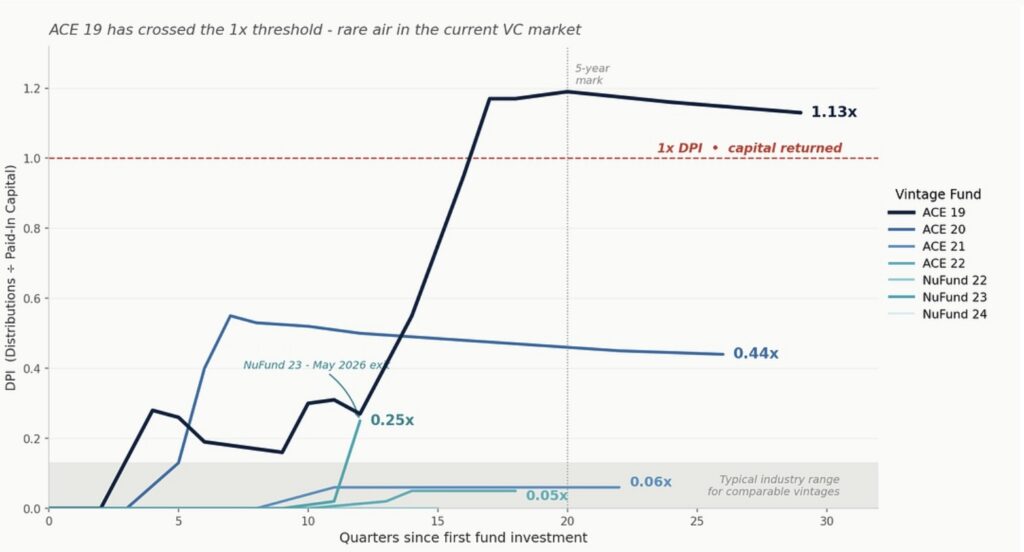
NuFund’s ACE Fund 19 (2019-vintage and inaugural Annual Fund) crossed 1.0x DPI in December 2025. The fund has returned more than the original capital that investor-members invested. Ten of the sixteen (63%) portfolio companies are still operating, and one just raised $20M. The 1x distribution came primarily through a breakout exit (more on that shortly), consistent with how the asset class behaves at the top of the distribution curve. In the broader market, we estimate only about 8-10% of 2019-vintage VC funds have achieved this milestone.
ACE Fund 20 (NuFund’s second Annual Fund) sits at 0.44x DPI with 12 companies still active. Some of its portfolio’s largest follow-on financings took place over the past year resulting in TVPI (unrealized + realized gains) of 2.77x, which is also in the top decile for its year, per Carta. Most 2020-vintage funds haven’t returned a dollar. Across all seven of NuFund’s historical vintages, NuFund is performing competitively at every comparable age.
That’s the headline. Now let’s talk about why.
Figure 1: NuFund Vintage Funds: DPI Trajectory
Source: NuFund fund accounting, updated for May 2026 exit activity; Industry reference: Carta Q4 2025 VC Fund Performance Report (2906 US venture funds)
ACE 19’s DPI trajectory crosses the 1x line around quarter 18. Industry median zone from Carta aggregate data.
Why This Shouldn’t Be Happening, Unless
The venture liquidity timeline isn’t broken. It’s just long.
VC funds are typically ten-year vehicles with options to extend to twelve or more. Startups are taking longer to reach exits. These two realities combine into the J-curve every mature LP has internalized: negative performance for the first few years as capital deploys, a slow climb as portfolio companies mature, meaningful distributions (hopefully!) typically arriving in years seven through nine, and final returns crystallizing in years ten or beyond.
However, there’s a counterintuitive wrinkle: early DPI isn’t always a good sign. A fund returning cash after two years usually means a company got acquired for not much, not that something went brilliantly right. So when people say “VC funds have given no money back,” they’re mostly right, and mostly that’s how the asset class works.
But within that structural reality, some funds consistently outperform. Not because they got lucky. Because they were built differently. Perhaps early-stage angel funds have a structural advantage?
A Different Species, Not A Different Tier
The most important thing to understand about NuFund is that it is not a smaller version of a traditional VC firm. NuFund is a structurally different vehicle operating in the same asset class.
Smaller funds outperform. Research backs it. The Colibri Institute’s February 2026 study analyzed 2,500 VC funds raised between 2000 and 2024. Emerging managers running smaller funds outperformed larger managers across DPI, IRR, and TVPI (Total Value to Paid-In Capital). From 2013 to 2022, 91% of the top-ten VC funds were below $250M in size, and 73% were below $100M. That’s the range NuFund operates in. The outperformance isn’t a coincidence. It’s structural.
The reasons become intuitive once you see them:
- Smaller exit thresholds. A $12M fund returns 1x on a $12M exit. A $1B fund barely registers it. Small funds can hunt in the middle of the distribution, not just the tail.
- Concentrated attention per company. Fewer investments per fund means sharper diligence, more portfolio support, and stronger founder relationships.
- Speed without committee-of-committees. NuFund moves quickly because it doesn’t need layers of approval. NuFund’s members are the committee.
- Collective expertise as an unfair advantage. In almost every deal, NuFund has members who understand the industry as deeply as the founders themselves. 300+ operators doing the pattern-matching, not one GP’s gut.
This is the Venture Group model as NuFund defines it. Unlike a traditional VC firm where two or three General Partners make investment decisions in exchange for management fees and carried interest, NuFund’s capital is deployed by its investor-members collectively with the underlying support of professional infrastructure and best practices. The members are the fund committee. And the due diligence team. And the subject matter experts. That’s a big reason why NuFund’s portfolio has a 90% survival rate at the unique-company level across 111 companies since 2019.
Engagement after the investment is core to NuFund’s philosophy and success. NuFund originally operated as TCA San Diego from 2001 until 2022. TCA Venture Group recently published an analysis in the ACA Data Insight Series (“Mitigating The Decline in Angel Board Representation”) that showed that MOIC on outcomes for companies with a TCA member as a Board Member realized 14 times better MOIC compared to the portfolio companies without a TCA Board Member. Now that NuFund is independent from TCA VG, NuFund continues that emphasis on active engagement and actively seeks board representation in all its deals — in 2025 82% of NuFund’s investments had a NuFund Board Member (compared to 17% for all angel groups submitting data for ACA’s Angel Funders Report). This emphasis is because such representation is a requirement to qualify for the largest checks from the Fund.
Different species, not a different tier. The math looks similar on the surface. Underneath, it’s built from different parts.
Honest Trade-offs: Where Consensus Works, And Where It Doesn’t
Before continuing, let’s name a real trade-off in NuFund’s current model.
NuFund’s Annual Fund is consensus-driven. That means NuFund’s deep bench of members, subject matter experts (SMEs), and diligence teams evaluate every investment together. This helps NuFund avoid mistakes that most investors wouldn’t. It’s why NuFund’s failure rate is significantly below the early-stage norm. It’s genuinely one of NuFund’s biggest advantages.
But consensus-driven processes also tend to lower the ceiling. NuFund’s Annual Fund is well-tuned for companies with validated technology, demonstrated traction, and a repeatability story. Much of NuFund’s decision weight sits on what can be technically verified and market-validated. That’s a strong filter that works well for companies at the Seed and post-MVP stages.
The venture outliers, though, the 100x+ winners that disproportionately drive most VC fund returns, don’t tend to come from the middle of that filter. They come from founder-conviction bets made before the validation existed. From backing the person and the vision when the data was still thin. That’s a different kind of decision than the one NuFund’s Annual Fund process is optimized for.
NuFund isn’t ignoring this and is constantly building new models to solve any blind spots.
The Numbers
Here’s how NuFund stacks up against the 2,906-fund Carta universe for comparable vintages.
Figure 2: The Patience Premium: NuFund vs. Industry

Source: NuFund fund accounting, updated for May 2026 exit activity; Industry reference: Carta Q4 2025 VC Fund Performance Report (2906 US venture funds)
Note: 1x+ DPI percentages for 2019-23 are extrapolated estimates. Confirmed anchor: 2017 vintage = 16%. Younger vintages decay sharply as fewer funds have begun returning capital
ACE 19 (2019 vintage): 1.13x DPI, ranks in the estimated top 10% of 2019 vintages on this measure. Unrealized TVPI is 1.74x.
ACE 20 (2020 vintage): 0.44x DPI, above the industry median. Unrealized TVPI is 2.77x.
ACE 21 (2021 vintage): 0.06x DPI, early in a vintage where most funds still sit near zero. Unrealized TVPI is 1.37x.
The 2022 – 2025 vintages are still in portfolio-building mode with $23.6M deployed across four funds, into 74 active companies. Zero DPI is the norm at this stage, but NuFund 23 is at 0.25x DPI already based on a significant exit in May 2026.
In aggregate across all seven active vintages: $37.1M deployed, 110 different companies (some with multiple fund investments), 9 profitable exits, 10 hard write-offs, 12 partial-loss exits or markdowns, the rest active. That’s the full picture.
The Power Law In Action
One number deserves its own moment: DTx Pharma alone accounts for over 25% of all Annual Fund distributions NuFund has ever made to its members. One exit out of 100+ investments driving more than a quarter of every dollar returned across every fund.
That’s the Power Law textbook illustration. Venture funds are not composed of a portfolio of dependable 2x returns. It’s a portfolio where most companies return between 0x and 2x, and a small handful return 5x, 10x, or more. The fund-level return comes from that handful. This is what venture looks like when it’s working.
Figure 3: Portfolio Health at NuFund
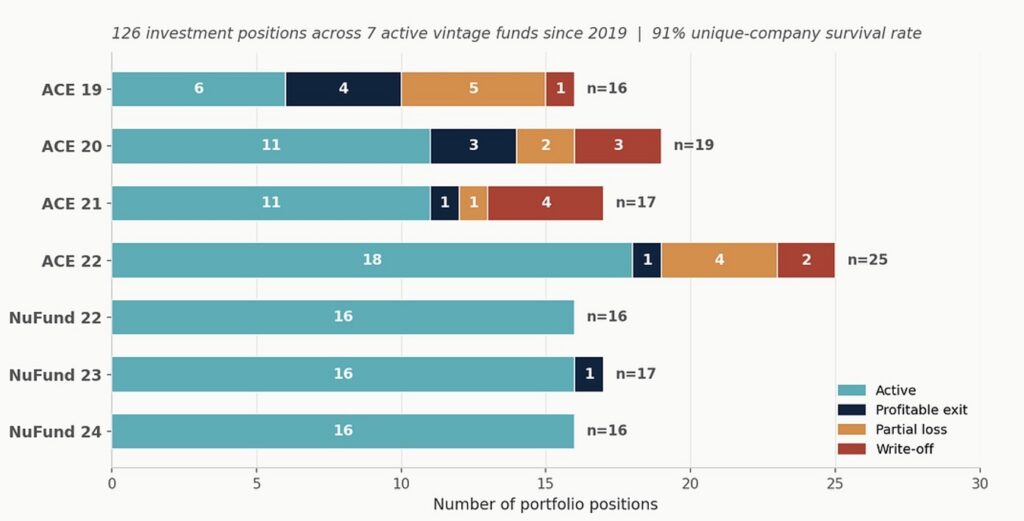
Source: NuFund fund accounting, updated for May 2026 exit activity. Partial loss bundles cram-downs and partial loss exits. Counts are investment positions
Which is why portfolio survival matters so much. NuFund’s 90% survival rate isn’t about being conservative. It’s about ensuring that when the next breakout emerges, NuFund is still in the deal. You can’t ride a Power Law winner you wrote off.
What This Means For Venture Group Members
Here’s the practical implication of the Power Law for any venture investor, not just NuFund’s members: because roughly one company out of every 30 to 100 drives 20% to 40% of total returns, participating across 8 to 10 vintages is what gives investors a real chance of being in the funds that catch those outliers.
Coming in and out year to year means likely missing the one or two breakout winners that define a decade of investor returns. Venture isn’t an asset class that rewards market timing. It rewards continuous participation. The math of long-duration commitments to a portfolio strategy is how returns compound enough to fund continued investing and make the overall portfolio self-sustaining.
That’s why NuFund thinks about membership as a long-term relationship, not a transaction. The members who’ve participated in every vintage since 2019 have exposure to the full distribution of outcomes (including DTx Pharma’s windfall). It’s just how venture math works. Or as one wise NuFund investor once stated, “People say that venture investing is gambling; they’re right, but if you make enough bets – you’re the House.”
Final Word
The broader market is wrestling with a real liquidity crisis. Funds raised in the 2021 boom are struggling. IPO markets still remain constrained for the most part.
Goldman Sachs just paid up to $965M for Industry Ventures because the secondary market has become core venture infrastructure, not a niche tool. Emerging funds across the industry are struggling to stay intact and relevant.
Against that backdrop, NuFund is in a meaningfully different position. Withfunds outperforming benchmarks . NuFund’s portfolios surviving longer, and afee structure that gives members more of every dollar earned, NuFund’s community is growing.
The industry data is clear: most VC funds struggle to return capital. Angel funds that engage their members and embrace best practices can perform much better.
Key Takeaways:
- Early-stage funds with engaged members can produce returns that beat VC’s by a long shot
- The key is to combine:
- An effective and thorough due diligence process with collective decision making by all the fund members
- Active engagement by a subset of the members with deep subject matter expertise and experience to assist each portfolio company after the investment is made
AUTHORS
Ashok Kamal, Executive Director of NuFund Venture Group
Serhat Pala, President NuFund Venture Group
Sources & Further Reading
- Carta, VC Fund Performance Report, Q4 2025 (2,906 US venture funds)
- Bain & Company, 2026 Global Private Equity Report
- Peter Walker, Carta public posts on VC fund DPI trajectory, Q4 2025
- Colibri Institute, Emerging Manager Performance Study, February 2026 (2,500 VC funds, 2000-2024)
- Cambridge Associates, Top-Performing Fund Manager Analysis (2004-2016)
- Angel Capital Association, “DPI: What Investors Seeking Liquidity Need to Know,” September 2025
- NuFund Internal Fund Performance Data (ACE 19-22, NuFund 22-25), through 20 April 2026
- NuFund Member Meeting, Pre-Seed Feeder Fund MVP Proposal, October 28, 2025
- NuFund Learning Center, “Pre-Seed Fund MVP Recap,” October 2025
- NuFund Fireside Chat with Paige Craig on Pre-Seed Investing, October 2024
- NuFund Surveys (Feeder Fund Interest Survey, Member Segmentation Survey)