

A conversation with Peng-Sang Cau, Director of Siemens for Startups

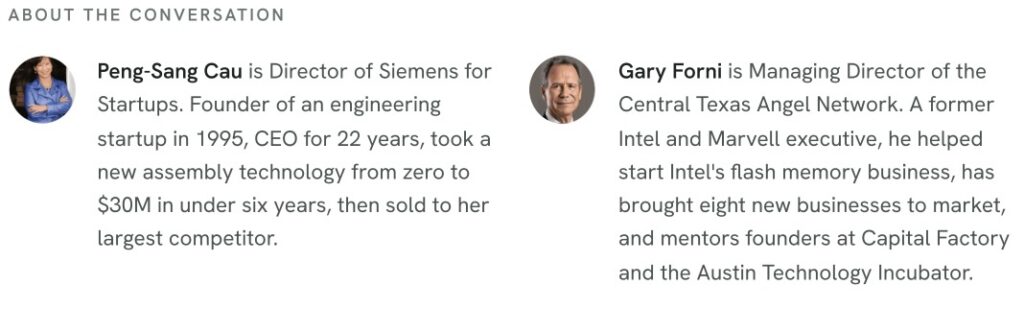
Peng-Sang Cau started an engineering company in her basement in 1995 and
ran it as CEO for 22 years. She took a new assembly technology from zero to
more than $30 million in sales in under six years, then sold it to her largest
competitor. Today she leads Siemens for Startups, where she works with
roughly 535 hard tech companies. Gary Forni, Managing Director of the
Central Texas Angel Network (CTAN), sat down with her to talk about what
angels misread about physical-product startups, how a digital twin can win a
customer before the hardware exists, and what to ask in the diligence room.

Gary Forni: Welcome. I’m Gary Forni, Managing Director of the Central Texas Angel
Network. We spend a great deal of time looking at founders and their ideas and trying
to understand whether there’s evidence that the team can actually move forward and
scale the business. That’s especially important in hard tech, where a poor engineering
decision can turn into a huge financial cost later on.
My guest today has lived that journey on both sides of the equation, going from a
basement startup to leading Siemens for Startups. Peng, welcome.
Peng-Sang Cau: Thank you, Gary. I appreciate you inviting me to talk about the
Siemens for Startups program. I wish it had been available when I started my company
30 years ago, but it is what it is. I’m excited to be here.
From a basement in Kingston to a global exit
Gary: Before we get into Siemens, I want to talk about that company. Take us from a
nascent startup in a basement all the way to international engineering and the sale of
the company, because that’s the story angels love.
Peng: I built a hard tech company back when there was no such word. I started it in
1995 in my basement. This was before entrepreneurship was fashionable and before
everyone talked about innovation, and in Canada in particular it was quite challenging.
My first factory was actually one of my partners’ garages.
We kept evolving until 2012, when we developed a disruptive technology called
CNCAssembly. We took it from zero to over $30 million in sales in less than six years,
which in hard tech is very challenging. We went to market with a virtual machine and
convinced our first customer to buy it, and over time they bought 14 machines. Over
those six years we developed six generations of the technology.
By year six, I was looking at how to scale. We were on four continents, but some of our
biggest potential customers, global brands you would recognize, were saying, “Peng,
you’re too small.” We were using the strategy from Crossing the Chasm by Geoffrey
Moore, which every high-tech founder should read, and we were trying to cross the
chasm in consumer packaged goods. The big gorillas in that industry said, “If we buy,
we buy 20 or 30 machines. You can’t build that many, and you can’t support them
globally.” And they were absolutely right.
So I started looking for investment, which in the Canadian market was very difficult.
Eventually one of my customers in the Netherlands said, “Peng, you’re known for your
innovation, not your operations.” That’s the difference between a hard tech company
and a software company: operations, service, and support all have to come into play
for you to be successful. They asked, “Why don’t you license your technology?”
So we went to our biggest competitor. Within half an hour, they said they’d like me to
talk to their VP of M&A. I said, “I’m not ready for M&A, but put a number in front of me
with enough zeros that I love it, and we can talk.” Within five or six months the deal was
signed, when I’d been told to expect 12 to 18.
That’s my journey: starting an engineering services company from my basement as
someone who isn’t an engineer, who didn’t even know what a mechanical or electrical
engineer does and had to learn all of it, and leading that company onto the global
stage. By the end, we were exporting about 99% of the machines we designed and built
in a little town called Kingston, Ontario.
Gary: That journey checks every box. A basement startup with a garage mentality, all
the way to an exit to a large company. Congratulations.
Why angels can’t use the SaaS playbook
Gary: Your founder experience is why your current role is so interesting. You’re not
approaching startups as someone who only knows the enterprise side. You know what
it feels like to worry about every dollar, about burn rate, about the months it takes to
get a product out.
Let’s widen the lens. Hardware, robotics, space, energy, and advanced manufacturing
are drawing renewed interest from investors. Here in Austin we have 20 space
companies, not counting SpaceX and Blue Origin, and we’re seeing it everywhere, down to small modular nuclear. Ten years ago everything was SaaS. From your seat
at Siemens, what’s driving that shift? Are angels equipped to evaluate these
companies, or are many of us still applying the SaaS playbook to fundamentally
different businesses?
Peng: I totally agree that many angels are not equipped to assess hard tech companies.
When I share my story with founders, it changes the conversation, because I’ve lived
their life. I know what it takes to start a company, build a production line, and build the
operation, and to worry about service and support, because selling is just one step.
But many angel investors I’ve met come from the Bay Area, from SaaS. You and I are
old enough to remember the dot-com hype and then the app hype. Let me be blunt:
those are much simpler businesses to run than a hard tech firm. In hard tech, it takes a
tremendous amount of capital just to buy the tools, software and hardware, to build an
MVP, and it takes much longer.
Then, once you’ve built it, how do you get to your early adopters? That’s problem
number two. With a SaaS product, the customer’s risk is much lower. In hard tech,
finding an early adopter is as difficult for the founder as finding an investor.
Corporate enterprise customers, whether it’s Siemens or Intel or Boeing, love to talk
about how much they love innovation. Then a startup comes to them and says, “I have
an innovative technology that will improve your revenue or cut your costs,” and they
ask, “Am I your first customer?” “Yes, sir, you are.” “Then I’m not interested. Come back
when I’m your hundredth customer.”
So I like to say that everybody loves innovation until you tell them it’s innovative, then
they don’t want it anymore.
"Everybody loves innovation until you tell them it's innovative, then they don't want it anymore."
I call it the ugly three-headed dragon. The first head is the long development cycle and
the amount of money it takes to build an MVP. The second is investors: there are
limited angels and VCs with the appetite for a longer-term risk than they’re used to.
The third is finding early adopters, because most people are afraid for their jobs. If they
buy the same old thing and it doesn’t work out, they don’t get fired. If they buy
something innovative and it doesn’t work out, that’s a different story. Every hard tech
founder has to slay that dragon to be successful and exit.
Gary: It reminds me of the old line: nobody gets fired for buying IBM. You buy the
tried and true, you keep your job, you know what you’re getting, and you won’t get
anything innovative.
Peng: Exactly. I had a sales rep who used to work for Pitney Bowes, and when he was
selling Pitney Bowes as a new company, the line was, “Nobody gets fired for buying
Xerox.” Everybody expects you to buy Xerox. If you buy Pitney and it doesn’t work out,
you may not get your raise or your bonus.
What tooling costs, and why the full version matters
Gary: As angels, we’re often trying to distinguish between what’s possible and what’s
actually investable and executable on a timeline we can support. One reason we
hesitate around hard tech is the belief that capital disappears into tooling and
development, and companies run out of money long before there’s a commercial
product. What do software, tooling, and engineering infrastructure costs look like for
an early-stage company? And how does Siemens for Startups change that math for
founders, and for the angels funding their runway?
Peng: The software tools are fundamental. They’re the very beginning. If you have a
disruptive idea in your head that no one has ever heard of, and you’re trying to solve a
major problem, it’s very difficult to describe.
Think about the elevator pitch. What I ask founders is, “How tall is the skyscraper
you’re trying to ride that elevator up?” Because your investor will lose interest. Let’s be
blunt: most investors, including me as an angel, are experts in our own areas, not in
every subject that comes through the door. So the goal is to get founders using tools
like Siemens NX to create a digital twin, so the elevator stays on the main floor. It’s so
much easier to build something in the digital world and show early investors: this is the
problem in the industry, and this is what I’m building to solve it.
As for cost, many of our competitors have similar programs, and some say theirs is
free. Siemens charges a minimal cost, and the reason is that we want to give you the
same tools your biggest competitors are using, not a free light version that limits what
you can do.
As a share of a company’s spending, software is substantial at the beginning, because
it’s what you need first. You could be an engineer, a physicist, or a chemist sitting in a
basement. You may not be taking a salary, and you don’t have hardware tools to build
an MVP yet, but you need that software to get what’s in your head into a computer,
into a digital twin, so you can communicate it to whatever audience you need to
reach. As you grow and scale, it becomes a much smaller percentage relative to your
other expenses.
Selling a machine that didn’t exist yet
Gary: You’ve brought up the digital twin twice now. When we think of engineering
software, we think, “This lets us get it right the first time, or close to it.” But you’re
positioning it as a sales tool, a way to win early adopters long before you’ve invested
the hard costs of building something. Can you expand on that?
Peng: Most founders in the technical space have an engineering background, so when
they look at a CAD tool, they see an engineering tool for designing a mechanism or a
circuit board. I came from a commercialization, marketing, and sales background.
In 2012, when we developed our disruptive technology, I didn’t have an investor.
Building our first alpha would have cost about $300,000, and I didn’t have that money.
So here’s the challenge: which one comes first? I don’t have the money to build the
alpha, so I cannot show it to my customers. My customer wants to see it, but I can’t
afford it.
So I had my engineers build a virtual machine. Back then “digital twin” wasn’t a word
yet. We designed the customer’s own product into the virtual machine and simulated
the features that mattered to that industry. In consumer packaged goods, with plastic
parts, that meant things like insertion rate and damage to the plastic. Because we had
years of history building traditional systems, we had real data to compare what those
systems did against what the new technology would do. That put data in front of the
customer and earned us a deeper conversation.
I knew we had something special when it moved from the plant project manager to the
plant engineering manager, to the plant manager, all the way to the VP. I remember
sitting in that boardroom and saying to him, “You and I both know I have something
special here. Normally the purchasing manager and the project manager make the final
call on these projects. The fact that you’re sitting here with me tells us both. Give me a
chance, and you’ll have the most disruptive technology to take to your own customers.”
He believed in me. They bought the first system, then 13 more over the next six years. I
used that virtual machine as a marketing asset.
Engineering tool, marketing asset
Gary: So where does the value of Siemens for Startups show up most? Lower spend,
faster milestones, fewer redesigns, early design wins, or increased sales?
Peng: Both!
Gary: I gave you five choices, not two.
Peng: But think about it. From an engineering perspective, you’re iterating on your
design with the digital twin. At my company, the engineers used simulation to keep
refining the product for efficiency, for production of the equipment, for any number of
things. While they were doing that, I was asking them to create virtual machines I could
turn into marketing assets.
Here’s another example. After my technology was acquired in 2018, we had to wind
down our existing projects, so I didn’t join the acquiring company until literally the day
the world shut down for COVID: March 30, 2020. I joined as VP of Emerging Markets
and had to launch a technology I had named Symphoni, which no one had ever heard
of. Same problem: what do I do? I couldn’t have customers flying into Canada to look at
it. If you search YouTube for Symphoni, spelled with an “i,” you’ll find the marketing
assets I created in those years, and a lot of the early ones are virtual machines built
from what the engineers had already done. We took it from zero to many millions in the
three and a half years I was there.
So through Siemens for Startups, we provide access to enterprise software tools for
CAD, simulation, and product lifecycle management, which is what you need to build
that digital twin. We also provide free co-marketing: podcasts, case study videos, and
events and conferences we invite our startups to attend and network at.
What I add because of my experience is this: beyond the engineering, you can use
these tools to help you commercialize. As I tell a lot of founders, if you don’t have
customers, you don’t have a company. So instead of waiting until the engineers build
the MVP before you talk to customers, why not have something in the digital world?
The technology has come so far since I did this in 2012, and what founders can
produce with our tools now is so real that you can have an intelligent conversation with
a customer around that digital product. You’re already building it for engineering. Just
take the same thing and create marketing assets.
Gary: I love that repurposing. The engineering work is already done, so repurpose
it as a marketing and sales asset. That’s clearly part of the value you bring as
an entrepreneur.
More than discounted software
Gary: We’ve all been wowed by a demo, told a company to go down that path, and
regretted it. I was so infatuated with a CRM ten years ago, and it probably slowed the
company down 15%. How should an angel encourage a portfolio company to evaluate
Siemens for Startups without getting pulled into the engineering manager role?
Peng: Having been an angel, I know how difficult it can be to influence a founder. The
best thing an angel can do is at least tell their portfolio companies that Siemens has
a program.
In a lot of my conversations with founders, the value isn’t just the heavily discounted
software or the co-marketing. Since I took over as director, part of my job has been
working across all the Siemens businesses and business units to build a holistic
ecosystem that helps startups scale.
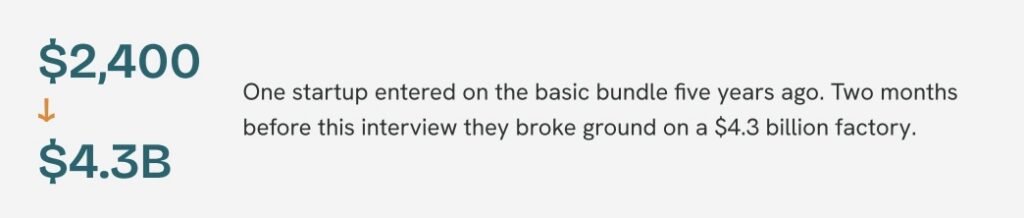
For example, one startup came in on our basic bundle, about $2,400, five years ago.
Two months ago they broke ground on a $4.3 billion factory. Along the way, we invited
them to many events, and they met many Siemens executives who helped them grow to
where they are today. Siemens is a huge, complex global company, and part of the
value I can bring is navigating it for founders. If you’ve developed a product that can be
sold on its own, you can list it on the Siemens Xcelerator marketplace, which sells
other companies’ products as well as ours. If you’re in mobility, that business unit runs
its own startup program for early proofs of concept, and I can make that introduction.
We have a corporate venture capital group, Siemens Capital. There’s so much in the
Siemens ecosystem we can bring into the conversation.
Funnily enough, Gary, I only found out about this program about three months before I
joined Siemens. I didn’t even know Siemens sold software. I’d known Siemens
automation for 30-odd years from my work in Europe, where it’s the industry leader,
but someone told me there was a Siemens for Startups program, and as an angel
investor and a mentor, including at Techstars Detroit, I wanted to bring that knowledge
to my startups.
From my perspective, if I’m going to put $100,000 into a startup, they can use that
money to buy the software, or they can use that money to hire the engineer to use the
software and accelerate their design. Which would you rather they do?
"If I'm going to put $100,000 into a startup, they can use that money to buy the software, or they can use that money to hire the engineer."
A twin that grows with the company
Gary: Once a company starts building its first physical product, how do you keep the
digital twin a true twin? And what are the advantages of keeping one running in parallel
after the product exists?
Peng: A digital twin isn’t just a model of your product. Take this can. It’s not only a
digital twin of the can. It’s a question of how you manufacture the can.
In the early days, with an MVP or an alpha or beta, volume is very low, so the process
is mostly manual. Instead of working out that process in the physical world, you build a
digital twin of the manual process. As the business grows and you convince customers
to buy, you’ll probably move to semi-automation, so what does that digital twin look
like? Then you keep progressing.
The startup I mentioned that’s building the $4.3 billion factory showcased their virtual
factory at a conference last September, before they broke ground. They worked with
our consulting group to build this massive virtual factory, and through Siemens’
partnership with Sony, I was able to put on a VR headset, walk through it, and see
where they were laying out their automation equipment. It gets down to that level of
detail, even showing how something is assembled.
From an investor’s perspective, where do you want your money going? They have to
build this product. Do you want them iterating in the physical world, where it takes time
and money, or in the digital world, where it costs less? At some point you have to build
in the physical world, but why not test your scenarios first? I can tell you from having
done it that it’s a lot cheaper in the digital world.
The technology can work, and the company can still fail
Gary: Beyond sales, there’s the classic engineering value: predictive maintenance,
remote monitoring, performance-based operation. As an angel, should I be probing
startups about their digital strategy and how it affects their moat? A digital twin lets
them not just articulate the separation between their product and everyone else’s, but
show it.
Peng: As an investor, you know this: technology is not why a lot of companies fail. It’s
the execution of that technology is why a lot of them fail.
"Technology is not why a lot of companies fail. It's the execution of that technology is why a lot of them fail."
If I’m investing, I want to know that after the alpha, the company can get to full
production. Have they thought about how they’ll execute? A founder may be brilliant
technically but not know how to build a factory. They need partners like Siemens, who
have done it for ourselves and for others. That’s why the digital thread and digital twin
are so critical. You want to know the founder is thinking about scale from day one and
using the latest technology to help them grow instead of going bust.
I met a founder at a conference who told me, “Peng, I don’t need to talk to you yet. I’m
building my third rev, because the first two failed and cost me $2 million.” I said,
“Pardon? You’ve spent $2 million, and you’re going to build your third rev without
putting it into the digital world first? You’re doing this all wrong.” Big enterprise
customers work with Siemens in the digital world to optimize their production lines. It’s
not only about efficiently designing and scaling your product. It’s also about the
efficiency of your production line.
Siemens also has subject matter experts who help companies plan greenfield and
brownfield factories. Lots of founders are brilliant, but that doesn’t mean they know
everything. You have to find partners who can bring that whole holistic service to
the table.
In the diligence room
Gary: Let’s bring this into the due diligence room, where the rubber meets the road.
Many founders angels see are exceptional engineers or scientists and first-time
operators. What signals tell you a technical founder has genuinely thought through the
path from prototype to production, and what should an angel look for to validate it?
Peng: Regardless of your technical background, do you understand what the market
looks like? That’s the first thing we look at as angels. My partners were all engineers,
and for 22 years as CEO I told them, “I do not want to hear about your technology
unless you can tell me the problem you’re fixing.” That’s how blunt I was.
When I talk to founders now, what I listen for is this: even if you don’t understand the
day-to-day operations of a business, is your ego small enough to accept that you’re not
the subject matter expert? Maybe you need to bring in partners, or talk to the angel
who has actually built a company and a production operation from the ground up.
From an angel’s perspective, look at whether the team understands production and
commercialization, or at least accepts that they don’t have that experience but
someone else does.
In the startups I work with, the teams raising a ton of money tend to have a core team
that understands production, operations, and sales and marketing, alongside the
brilliant scientists or engineers. And when I meet a very technical founder, I ask right
away, “What problem are you trying to solve? And would you be comfortable with
a CEO who understands that?” Then I watch how willing they are to learn from you
and from the people you bring to the table. I meet too many people who don’t want
to learn.
Gary: That’s an easy red flag. For an angel who isn’t a technical specialist, what should
they understand about digital twins when assessing whether a company is building for
durability and scale, rather than just wowing us with a working prototype?
Peng: I’d look at whether the digital twin has enough data behind it. When a founder
says their product will beat the traditional system, can they prove it through
simulation? As I used to tell my team, if you don’t understand the market’s headache,
how can you prescribe a drug? What is the market headache, and does what you’ve
designed in your digital twin address the specific problem you’ve told me about?
I’m not technical myself, Gary. I have a sales and marketing background. I’ve just been
in the engineering space for 30 years, both hardware and software. When I talk to
engineers, and as an angel, I deliberately don’t want to get into the technical details. I
want to know what problem you’re solving and how you’ll prove it to me. So they
should be able to show me the simulation data, “This is the problem, here’s what we’re
doing about it, here’s the data,” and then I’d dig a little deeper into where the data
came from. Can I trust the data?
Gary: So give us one plain-English question every angel should ask in a hard tech
diligence meeting.
Peng: How are they planning to scale from a production perspective? That’s usually
where companies fail. And on commercialization: which industry are they trying to
cross the chasm with, and what support and services will they provide?
Gary: And what answer would be an immediate red flag?
Peng: When a company hasn’t thought through production and shows me a hockey
stick, I can pretty much guarantee it’s going to fail. In hard tech, a hockey stick rarely
ever happens. If I see one, it tells me they haven’t thought through how difficult it is to
set up production.
Or when they say, “We’ll just outsource.” When I was a founder, the buzzword was
outsourcing to China. You haven’t thought about how they could take your IP, or the
logistics of bringing it all back in. But if a founder is systematic, “We found this partner,
we’ll keep the core technology in-house and they’ll handle production; we’ve talked to
a couple of customers who are interested provided we can build the alpha; we have a
letter of intent,” that’s different.
I think using a digital twin to earn that LOI is really useful from an investor’s point of
view. With a digital twin, you can have an intelligent conversation about the actual
problem you’re solving. It’s no longer theoretical. By then you should have talked to a
handful of potential customers and be solving their real problems, not what you think
their problems are.
Gary: I love that, because it moves away from “magic happens and the hockey stick
goes up,” and a digital twin gives you a way to prove it out.
Peng: And beyond that, you can use the digital twin to prove out your production.
Production at low volume is very different from production once you’ve crossed the
chasm. With early adopters on the near side of the valley of death, your production
model looks nothing like it will on the growth curve, when you start thinking about
automation. I don’t expect founders to be thinking about automation yet, especially at
the stage angels invest. But at minimum, they should be thinking about production and
sales and marketing in that early timeframe. To me, that determines whether they
succeed or fail. You can have the best technology, but if you don’t know how to sell it
or produce it, it’s still going to die.
What gets founders to say, “How do I sign up?”
Gary: I have a lot of space and robotics companies here. In your first conversations
with a startup, what do you tell them that creates pull, where they say, “Mr. Angel
Investor, you’re not wasting my time. I actually need this”?
Peng: Aerospace and defense is probably 40% of my business, because the technology
is complex and the production is complex. If you’re building something for space, it’s
hard to test on Earth something meant to work on the moon, so you need very
complex simulation. That’s why we have so many aerospace and defense customers,
enterprise and startup.
Every time I go to a conference, or my team books meetings for me, I tell startups what
I’ve been telling you: use the digital twin and the digital thread to de-risk your
development and your production, and here’s the ecosystem we bring, including being
associated with the Siemens global brand. I’d say about 90% end up asking, “How do I
sign up, Peng?”
Gary: Then tell me about onboarding. And after a year of using the tools, what
happens next?
Peng: If they’re interested, we introduce them to a channel partner. Unless you’re a
billion-dollar-revenue company, startups don’t usually buy direct from Siemens, so we
work with third-party distributors certified by Siemens. They have engineering
resources to support the startup, they’re usually local, and they’re usually in the
startup’s vertical, so they bring best practices into the conversation. That’s the
beginning of the journey.
After that, I tell startups: I work with 535 companies, and it’s next to impossible for me
to remember everyone. It’s no different from getting an angel’s attention. Reach out to
me if you want to be on our podcast. We’d love to host you. It gives you a chance to tell
your story, we publish it through Siemens’ social media, it gets executives interested,
and it reminds me that you’re doing something interesting when we have events to
invite you to.
It always shocks me when founders say they’re not interested in events. Networking is
critical. It was my success as a founder. I attended everything, because you never know
who you’ll meet who will move the needle. The most successful founders in our
program are the ones who show up when we invite them, because the more events you
attend, the more Siemens leadership you meet. I don’t do it all, and I can’t do it all. I just
open doors, and it’s up to the founders to decide which doors to walk through and how
involved they want to be.
Gary: When you say events, does Siemens sponsor booths or bring startups to
trade shows?
Peng: Absolutely. We may sponsor an event or have extra tickets for our startups. I’m
speaking at New York Climate Week at the UN, and we’ll have 10 tickets to give to
startups in our sustainability ecosystem. In April, Siemens USA led a delegation of
about 100 companies, from big global firms to small and medium-sized businesses, to
Hannover Messe, the world’s largest automation trade show, and made room for three
of my startups. That week they networked with Siemens leadership across business
units and with executives from those companies, which is a chance to find customers.
Earlier this month I was in Indianapolis for the Brickyard 400, a Siemens-sponsored
NASCAR event with representatives from multinationals that are Siemens customers,
and we made room for a couple of startups there too. There were VCs and angels in
attendance. At the UN event there will be VCs, an angel investor, and policy makers.
You just never know who you’ll meet that moves the needle. That’s what I keep
telling founders.
Three closing questions
Gary: As we draw to a close, three short questions. First, what’s one expensive mistake
you wish every hard tech founder could avoid?
Peng: Thinking you can do everything. I’ve met too many brilliant scientists and
engineers whose egos are so big and who are so excited about their technology that
they think they can do it all. One of my own business partners used to tell me sales and
marketing was a waste of time. I disagreed, ignored him, and kept going.
Too many brilliant technical people brush off every other function as unimportant,
when in reality you need all the pieces of the puzzle, especially in hard tech. It’s so
much more complex than a typical SaaS company, where you need smart people and
computers and you can build it. In hard tech, even once you sell the product, how do
you service it globally without a global service team? Those questions have to be
answered. The founders who succeed build a team around them and respect the skills
each person brings.
Gary: Second, what’s one question every angel should ask before backing a physicalproduct company?
Peng: If you grow, how will you expand the business? How will you expand production?
It’s not enough to say, “I’ll outsource it to China,” or wherever the next cheap country
is. I want to hear that they have a plan and have thought it through. They may not
have every deal signed or the supply chain mapped out, but they should understand
its complexity.
I also want to hear that they understand what commercialization means. Marketing an
incremental technology is very different from commercializing a disruptive one. When I
explain that, are they listening, or rolling their eyes? I’ve seen a lot of engineers hear
“marketing” and think it means someone who can do graphic design. It’s like saying
you’re a civil engineer, so you’ll build the next spaceship. Maybe not. You don’t have to
be the expert, but you should have talked to enough smart people to know which skills
you’ll need to build your team, even if you can’t afford them today.
Gary: That’s a good indicator that a founder is ready to move from prototype to
production. Their vision may be more mature than their product, but they’ve thought
through the next steps.
Peng: Yes. Just because you have the best mousetrap doesn’t mean your product will
take off. You have to figure out how to build the mousetrap and how to sell it. At
minimum, as a founder, you’ve thought about it and realized you need experts to help
you succeed.
Gary: I love your example of the partner who said sales and marketing weren’t
important, because if the product is good enough, customers will come. That’s not how
the real world works.
Peng: I once had a CEO, who I won’t name, ask me, “Haven’t you done enough that they
should just buy from you without us having to do anything?” I said, “This isn’t cotton
candy! These are multimillion-dollar deals.” Out of sight, out of mind. You and I both
know that about sales.
Who it’s for, and how to connect
Gary: For a founder reading this and thinking, “That describes the problem I’m facing,”
who is Siemens for Startups designed to help? And how will founders find out about it
in time for it to matter? You found out about it only three months before you joined.
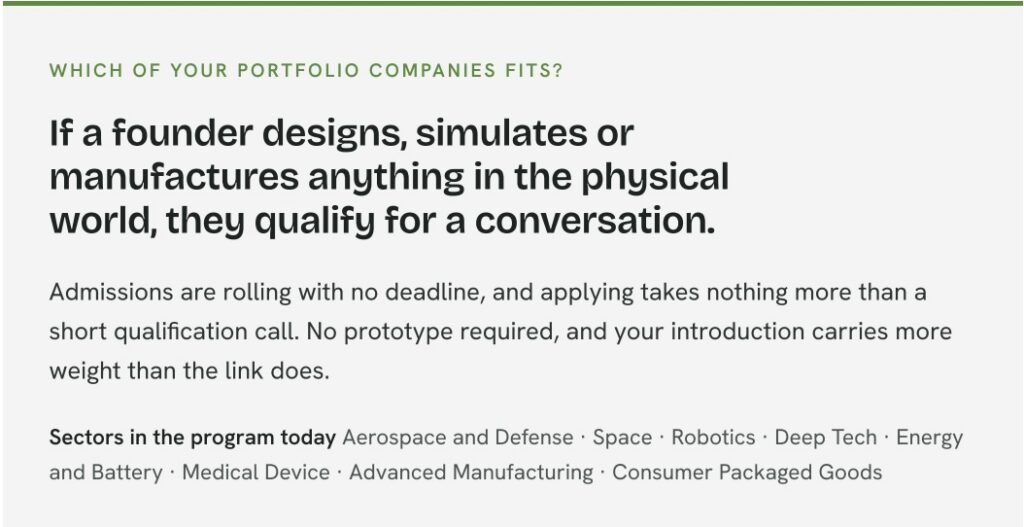
Peng: Siemens for Startups, particularly my division, Digital Industries Software, is
designed for hard tech founders, whether you’re in life sciences and medical devices,
consumer packaged goods, aerospace and defense, energy, or batteries. Anybody
building something in the physical world. If you’re a SaaS or AI company, we’re not for
you. We’re here for hard tech founders, probably the most difficult sector to scale and
grow in.
Since I took over, with my background in sales and marketing, I’ve focused heavily on
building the Siemens for Startups brand. I’m very active on social media, we highlight
our startups in many ways, and we sponsor events like the ACA conference, which is
how we met the Angel Capital Association. We’re working with angels, VCs, incubators,
and accelerators to get the name out there, so that at minimum someone says, “Have
you heard of Siemens for Startups? Go talk to Peng.”
To find us, search “Siemens for Startups.” You can also find me on LinkedIn as PengSang Cau. Send me a message or an email, and we can have that early conversation
about how we can help. I’m not here to waste your time or mine. We’re here to help the
founders who want to work with us.
Gary: Peng, thank you. What I appreciate about this conversation is that it connects
two forms of leverage founders need early on: knowledgeable capital and enterprisegrade capability. CTAN’s role is to bring investors, scar tissue, experience, and relationships to promising companies. Siemens for Startups brings tools, engineering resources, and a path into a much larger industrial ecosystem. They’re different roles serving the same objective: helping strong founders grow their companies while taking on less risk.
Peng: You’re absolutely right. When you look at what makes a company successful, you
can’t take away any of the pieces of the puzzle. They all have to come together. The
most successful founders are the ones who acknowledge, “I need all of it. Who do I
need to reach out to to make it happen?”
Gary: Wonderful. I hope this is the beginning of a broader conversation between
Siemens, the Angel Capital Association, and the founders and investors we all serve.
Thank you for joining us.
Peng: Thank you, Gary.