


AI has played a prominent role in investing in the last few years. While much of the focus has been on later stage AI companies, what can be said about AI investing in early-state companies? Below is what we’ve learned by looking at the investments in 2025 by 66 Angel Groups in the data collection effort for the 2026 Angel Funders Report.
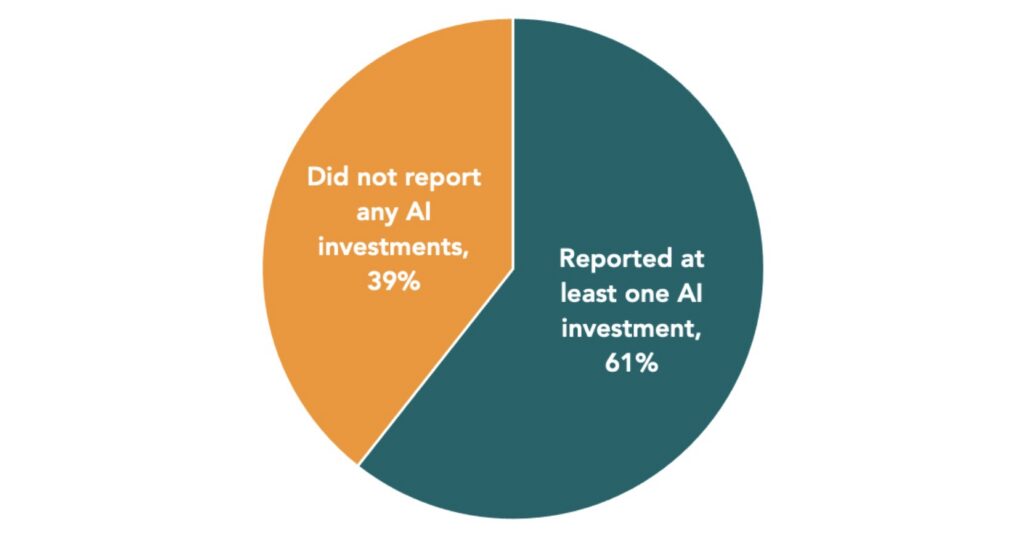
AI is now a material part of angel group activity, with 61% of reporting groups indicating at least one AI investment. 2025 was the first year the survey included questions specifically related to AI, but the data in FIGURE 1 show that AI is not just a niche theme and is now present in the majority of angel group portfolios. AI exposure is likely to become an increasingly important lens for evaluating sector strategy, diligence practices, and portfolio construction.
Figure 1. Almost 2/3 Of Groups Reported At Least One AI Investment In 2025
Source: Angel Capital Association 2026 Angel Funders Report
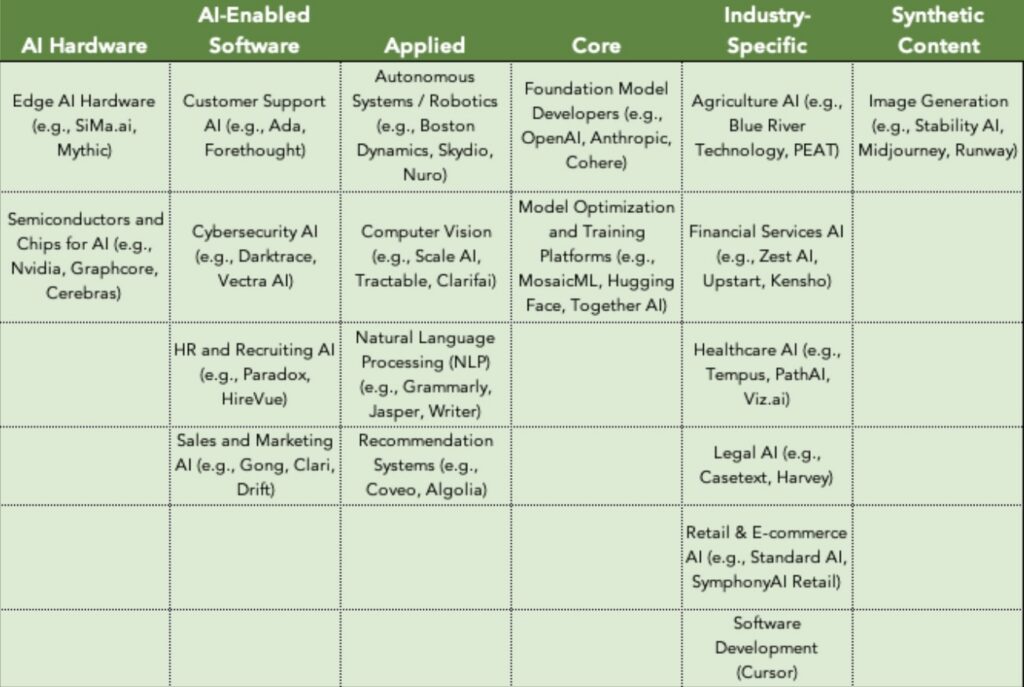
FIGURE 2 details AI vocabulary and definitions used in the 2025 survey with examples of companies in each category. As AI is a relatively new theme in angel investing, the ACA believes it is important for investors to begin normalizing language and definitions in this sector to improve overall understanding.
Figure 2. AI Definitions Used
Source: Angel Capital Association 2026 Angel Funders Report
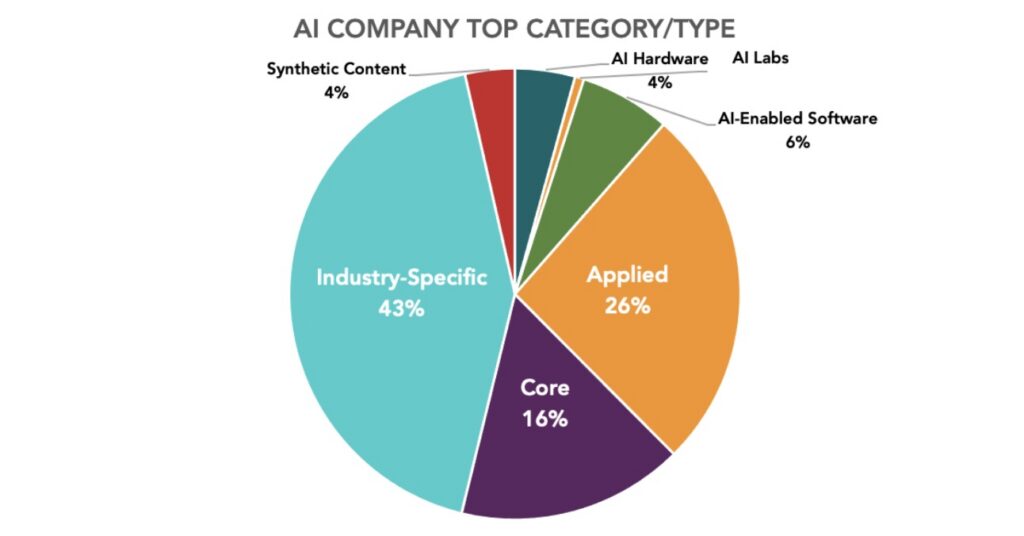
FIGURE 3 shows that angels invested less in general-purpose AI tools than they did in vertical, use-case-driven applications. Among categories of AI investments (dollars not count), Industry-Specific AI was the most common investment target, representing approximately 44% of total AI deal funding. Industry Specific AI is made up of the following subsectors: Healthcare AI (largest contributor), Financial Services AI, Retail/E-commerce AI, Agriculture AI, Legal AI, and Software Development AI. Applied AI was the second-largest category at 24%, driven primarily by its largest subsector, Recommendation Systems, and also including subsectors: Natural Language Processing (NLP), Autonomous Systems/robotics, and Computer Vision. Core AI accounted for 17%, including investment in subsectors, model optimization and training platforms, and Foundation Model Developers. By contrast, AI-Enabled Software only represented 7%, while AI Hardware and Synthetic Content each accounted for roughly 4%, indicating that angel groups are not investing in foundation-level generative-content technology, where mega-rounds funded by the largest VCs dominate. While, again, this is a single-year snapshot and does not show year-over-year change, the distribution suggests that angels are favoring AI companies with clear industry workflows, customer pain points, and commercialization paths. Looking forward, the strongest AI opportunities for angel investors may come less from foundation “AI platforms” and more from companies applying AI to specific sectors where proprietary data, domain expertise, and measurable productivity gains can create defensible moats and real, near-term value.
Figure 3. Most Angels Investing In AI Did So Outside Core AI
Source: Angel Capital Association 2026 Angel Funders Report
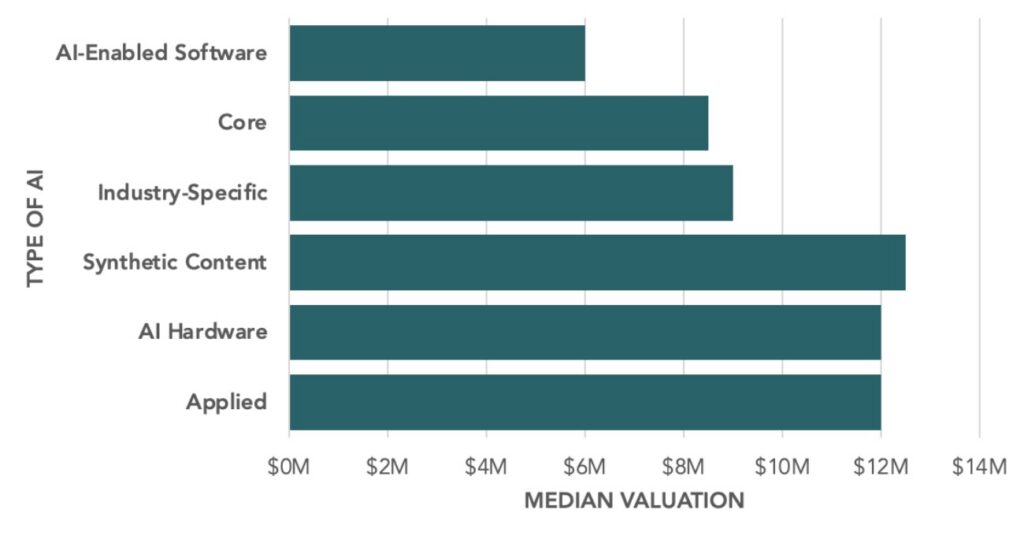
FIGURE 4 shows that AI company valuations vary materially by type, with the highest median valuations concentrated in more infrastructure-oriented or technically differentiated categories. Applied AI and AI Hardware led AI investments, each with a $12.0M median valuation, followed by Synthetic Content at $10.0M. Industry-Specific AI, the largest category by deal count with 83 companies receiving capital, had a $9.0M median valuation, above the overall AI median of $8.0M, suggesting investors are willing to pay a premium for AI companies tied to clear vertical workflows and customer use cases. By very slight contrast, Core AI companies had a median valuation of $8.5M, while AI-Enabled Software had the lowest median at $6.0M, despite being a common and broadly accessible application area. In 2025, AI investors assigned slightly higher valuations where AI is embedded in differentiated technology, hardware, or applied systems, and lower valuations where AI may be perceived as a feature layer within conventional software. Again, the differences in valuations are slight, except for AI enabled software, where differentiation is much weaker and the moats are shallower. These findings indicate that AI valuation premiums may increasingly reflect defensibility, proprietary data, technical depth, and evidence of market adoption rather than the “AI” label alone.
Figure 4. Valuations Highest In AI Hardware And Applied AI
Source: Angel Capital Association 2026 Angel Funders Report
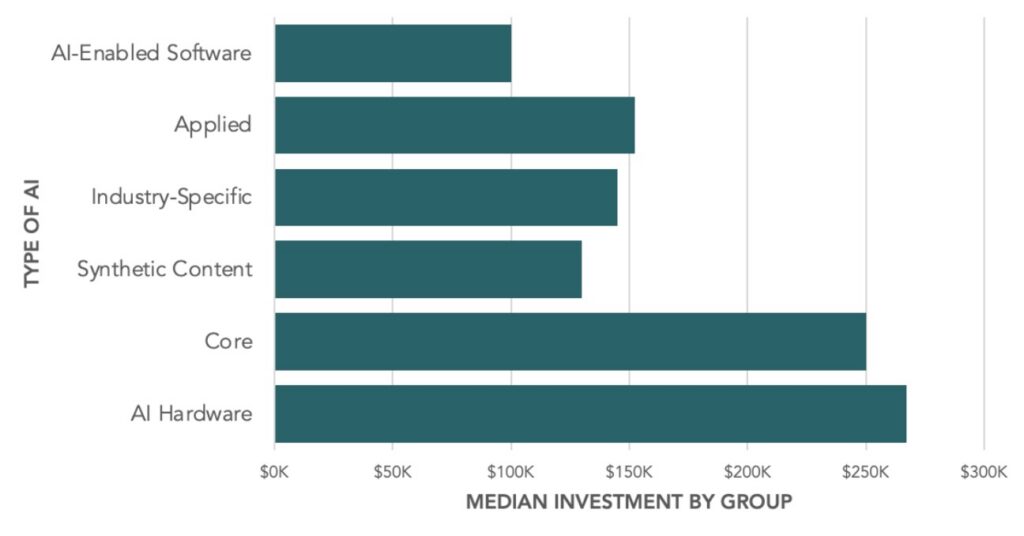
FIGURE 5 shows that median angel group investment deal size by dollars varies meaningfully by AI technology type, with the largest typical commitments concentrated in infrastructure– oriented and technically defensible categories. AI Hardware led with a median group investment of $267K, followed closely by Core AI at $250K, confirming that investors are willing to write larger checks where capital requirements, technical complexity, and defensibility are higher. Mid- tier categories included Synthetic Content at $180K, Industry-Specific AI at $143K, and Applied AI at $138K, while AI-Enabled Software had the lowest median investment at $100K. The spread between AI Hardware and AI-Enabled Software is roughly 2.7x, indicating that angels are not treating all AI companies alike. The data reinforce a clear investor preference: AI companies with deeper technical infrastructure or core model capabilities command larger median commitments, while more application-layer software companies may need stronger traction, proprietary data, or clearer differentiation to attract comparable funding.
Figure 5. Investment Highest In Core AI And AI Hardware
Source: Angel Capital Association 2026 Angel Funders Report
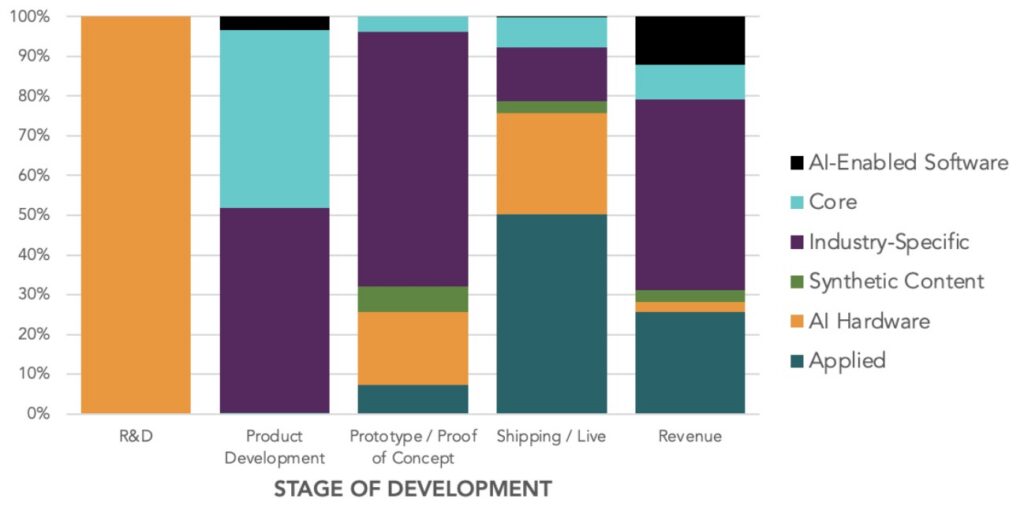
In terms of the Stage Of Development of the company, FIGURE 6 shows Applied AI is more common in companies that have progressed more and are either Shipping/Live or in Revenue. The companies at the R&D stage were all AI Hardware. At the Product Development stage, the companies are split between Industry-Specific and Core AI, and Industry Specific dominates the Prototype / Proof of Concept stage.
Figure 6. AI Investment Mix By Stage of Development
Source: Angel Capital Association 2026 Angel Funders Report data set
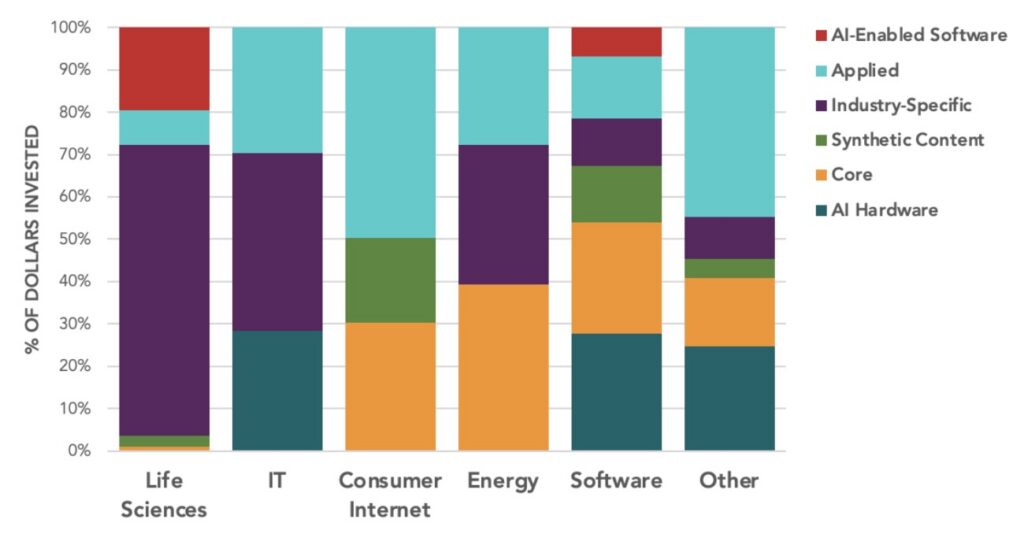
FIGURE 7 displays the differing mix of AI categories within Industries as a % of dollars invested. As different industries lend themselves to different types of AI technology, angel investors are not treating “AI” as a single homogeneous theme but rather selecting the right type of AI for the right industry. For example, nearly 70% of dollars invested in AI related Life Sciences deals were in Industry Specific AI, with very few dollars going to other types of AI; in contrast, AI related Software Industry investment dollars were broadly placed among all AI technology types. IT, Consumer Internet, and Energy Industries saw investment dollars flowing to only 3 of the 6 AI tech types. Overall, AI investment trends vary greatly by Industry, therefore, it is essential that angel investors pay attention to the intersection of AI technology types by Industry to make sound investment decisions.
Figure 7. AI Investment Mix By Industry Sector
Source: Angel Capital Association 2026 Angel Funders Report
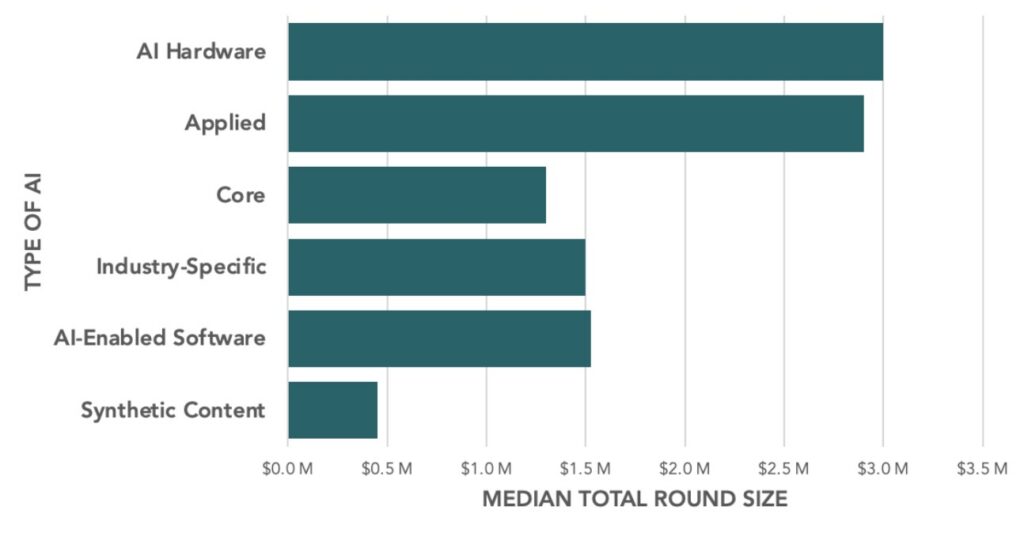
FIGURE 8 shows a large range in median round size (by $) by AI technology type, with the highest levels concentrated in infrastructure-oriented and applied AI categories. AI Hardware led at $3.0M, closely followed by Applied AI at $2.9M, suggesting investors assign the greatest value where AI is tied to technical infrastructure, specialized systems, or practical deployment. A second tier included AI-Enabled Software at $1.5M, Industry-Specific AI at $1.5M, and Core AI at $1.3M, while Synthetic Content was the clear trough at $410K. The spread from $410K to $3.0M represents more than a 7x range, underscoring that the market is not treating all AI categories equally. The 2025 data suggest that future AI funding and valuation strength will likely depend on defensibility, infrastructure depth, and applied commercialization rather than broad association with the AI theme alone.
Figure 8. Median Round Size Varies Drastically By AI Tech Type
Source: Angel Capital Association 2026 Angel Funders Report
One final thought. In late 2024, a prominent Life Sciences-oriented angel group convened a panel of big pharma companies and asked them about their engagement with AI companies, to help better understand the exit landscape. All noted that they are gladly doing collaborative projects with AI companies, but none were acquiring AI companies, which, suggests exits for these types of industry-specific AI companies may be problematic.
Further, increasingly the big AI companies are building their own solutions using their own advanced LLMs, which may mean that a whole generation of AI firms that are building user-friendly interfaces on the back of existing LLMs may have a tough time surviving. IMHO, in five years we may be looking back on a “mass-extinction” event more significant than any that we’ve seen before in early-stage investing (with possible exception of the mass demise of many consumer internet applications after the dot-com bubble burst in 2001).
Key Takeaways
- Most Angel Groups are active in Ai investing, with 61% investing in at least one AI company in 2025
- Almost half of investments (43%) are in Industry-Specific AI companies, and relatively few (only 16%) in Core AI (companies such as Anthropic and Open AI). This is likely because the investors in Core AI are investing many orders of magnitude more dollars – well beyond the size of angel funds and angel member investible assets
- The second largest category was Applied AI (with 26% of the total $’s), again likely because the round sizes are smaller relative to Core AI
- The Type of AI investment varies dramatically across industry verticals
- Future exit opportunities for AI companies may be a consequence of LLMs developing specific solutions, and industry specifics being reluctant to acquire AI companies.
AUTHORS
John Harbison, Chair Emeritus of TCA Venture Group and ACA Data Analytics Committee Chair
Kaison Giles, Cowtown Angels